ELEKTRO-WÄRME-AACHEN
Glossary
Technical terms related to vacuum drying
The most important terms from A to Z, explained in a concise and understandable way.
Here we explain technical terms that appear on our product pages. Is a term missing or is something unclear? Write to us via the Contact page.
Working volume
Usable interior volume of the chamber in liters. In our devices, the number in the name stands for the working volume rounded to full liters; for example, the EWA VETK 27 has approximately 27 liters.
Final vacuum
The final vacuum is the lowest pressure that a system reaches in operation. It is stated in mbar. The lower the value, the less residual gas remains in the chamber. The value is usually given as a number with a power of ten, for example 1 × 10⁻² mbar. This corresponds to 0.01 mbar or 1 Pa.
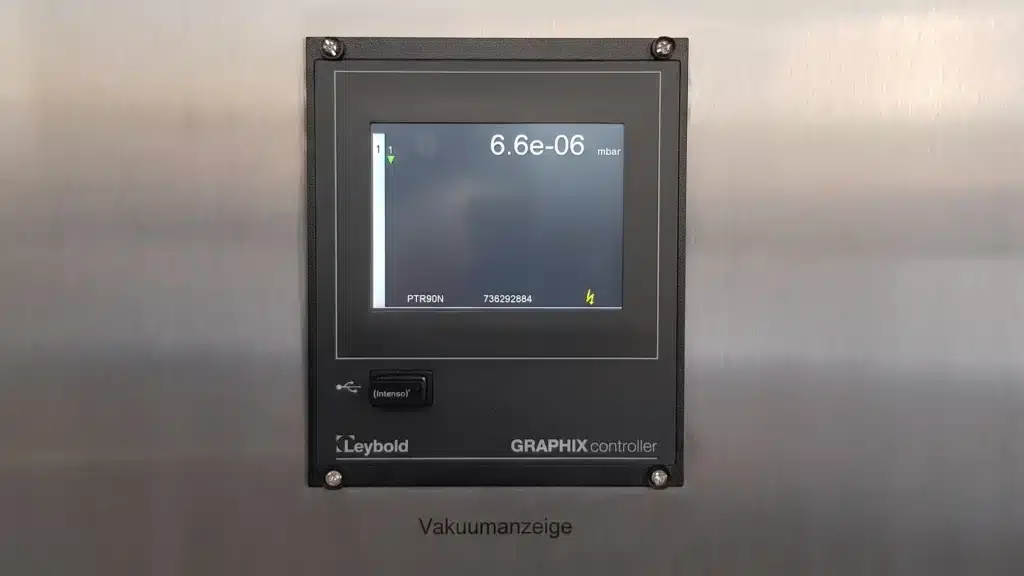
The photo is a real shot from the operation of one of our devices, not a representation on a computer. It shows the high quality of our products.
Explosion-proof version
Design for processes where explosive mixtures can form, for example through solvent vapours. We will clarify together with you the requirements applicable in a specific case based on your process.
GMP
Good Manufacturing Practice (GMP). These are rules for manufacturing in the pharmaceutical industry and related fields. „GMP-compliant“ means that a device is designed so that it can be used in a GMP environment. This includes high hygiene requirements, such as smooth and easily cleanable interior surfaces.
Hastelloy® (Alloy C-22, material 2.4602)
Hastelloy® is the brand name of a group of nickel alloys with very high corrosion resistance. At our company, Hastelloy® C-22 is used, also known as Alloy C-22 or material 2.4602, a nickel-chromium-molybdenum-tungsten alloy. It is chosen when stainless steel would be attacked by aggressive media. In the EWA VETK 2000, this material is additionally used in the stainless steel interior. Hastelloy® is a registered trademark of Haynes International.
Hygienic design
Equipment for hygienically demanding areas should be easy to clean. For this, smooth interior surfaces without gaps and dead spots are important, for example electropolished. The type of design you need depends on your requirements and the intended use. Depending on the order, the design may differ.
Inert gas
Non-reactive gas, for example nitrogen. It is used to vent or purge the chamber so that the product does not react with oxygen.
Isolator
A closed work area that separates the product from its surroundings. Work is done using built-in gloves. This protects the product and operator and facilitates compliance with high hygiene requirements.
Contact drying
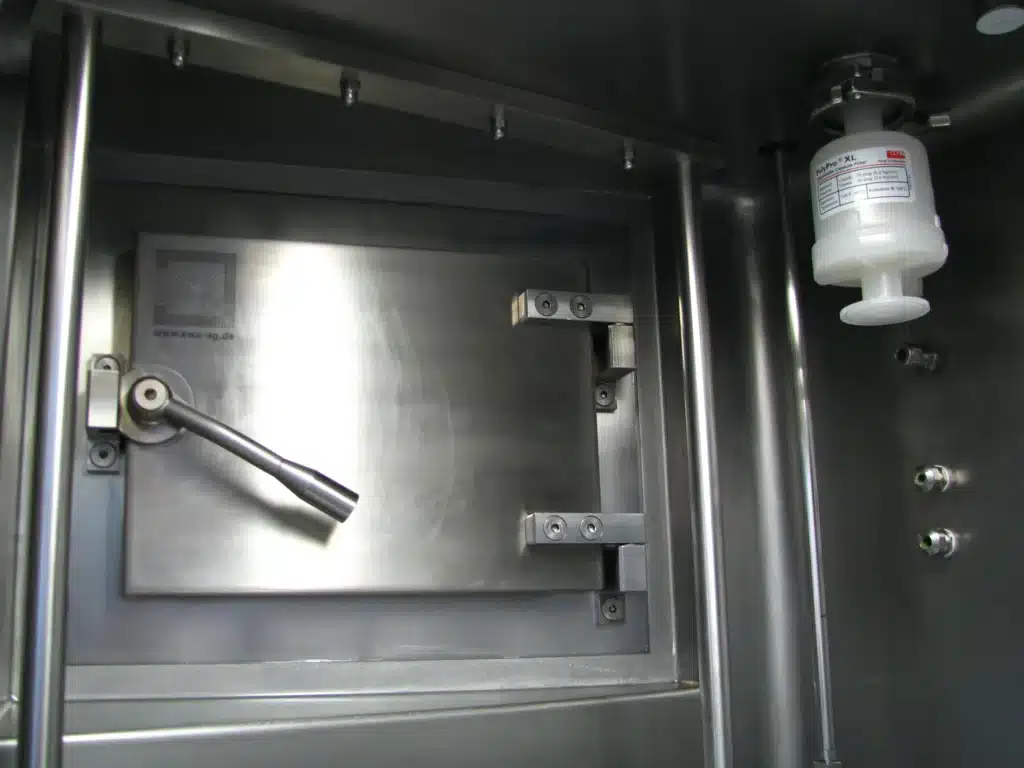
The heat is delivered directly to the material to be dried via heated surfaces, for example heated shelves (trays) and walls.
mbar (Millibar)
Unit for pressure. 1 mbar corresponds to 100 Pascal. The normal air pressure is about 1013 mbar. A vacuum is a pressure significantly lower than that.
Surface roughness (Ra)
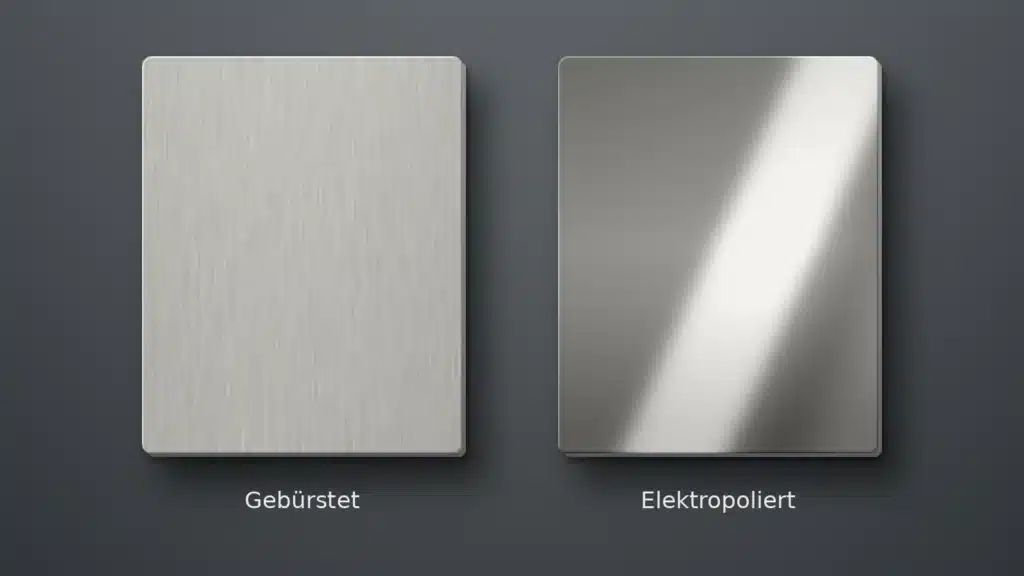
Surface roughness describes how smooth a surface is. The value Ra is common. It indicates the average roughness in micrometers (µm). The smaller the value, the smoother the surface. Smooth surfaces are easier to clean, and residues are less likely to stick. This helps meet high hygiene requirements, such as those found in the pharmaceutical industry.
The roughness also depends on the process, for example grinding, brushing, pickling or electropolishing. In electropolishing, an electrochemical process removes a very thin layer and smooths the surface. Which surface a device receives depends on your requirements, the intended use, the product data and, finally, the budget. For example, Ra inside the EWA VETK 27 is below 0.8 µm. These are the specifications given on the product pages. Depending on the order, the design may differ.
Custom-made
Equipment that is built to your specifications. All EWA devices are custom-made to customer specifications.
SPS
Programmable logic controller (PLC). It automatically controls processes such as temperature, vacuum and time.
Drying cabinet and drying chamber
We call a device a drying cabinet if its working volume is below 1000 liters. From 1000 liters upward, we speak of a drying chamber. This is our own terminology. In general usage, people mostly say "cabinet", even for larger devices.
V4A (material 1.4571)
Stainless steel with molybdenum and titanium additions. It is more resistant to acids and chlorides than the common V2A steel (1.4301).
Vacuum drying
Drying at reduced pressure. This lowers the boiling point of liquids. Moisture and solvents evaporate at low temperatures, which protects temperature-sensitive products.